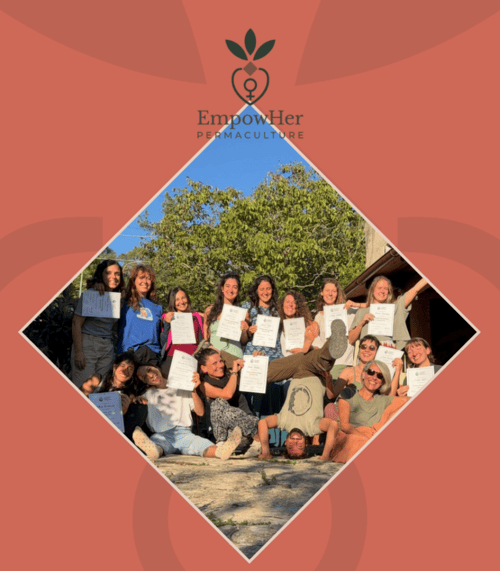
EmpowHer Permaculture
EmpowHer Permaculture is a European project (2024-1-IT02-KA210-ADU-
We believe that many answers to the social and ecological crises we are experiencing already exist: they are held in everyday gestures, in practices passed down through generations, in forms of knowledge that have often remained at the margins, as well as in major actions, in knowledge and in study.
EmpowHer Permaculture was created to make them visible, shareable and alive, starting from women.
Permaculture and empowerment
For us, permaculture is not only a method of ecological design. It is a way of reading the world and acting within it, placing care for the earth, people and relationships at the centre. Through permaculture we learn to:
- observe cycles and respect time;
- work with what already exists;
- value diversity;
- imagine regenerative, non-extractive systems.
In this project, permaculture becomes a tool for women's empowerment, capable of connecting concrete action, personal awareness and collective transformation.
The EmpowHer Cards
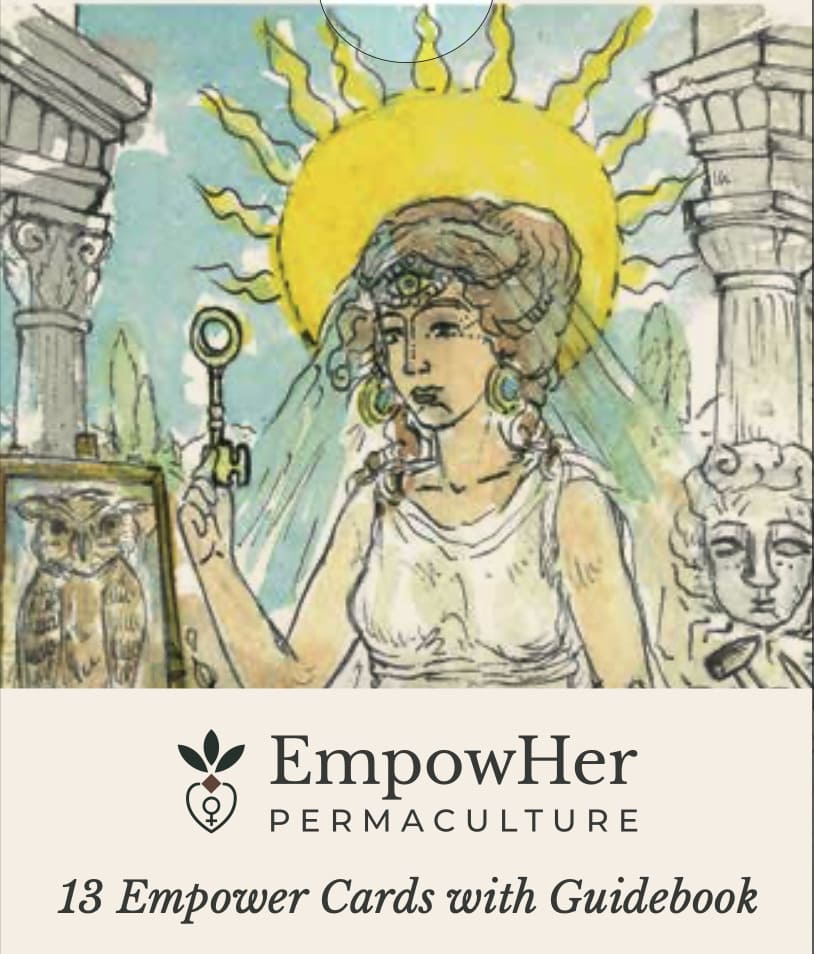
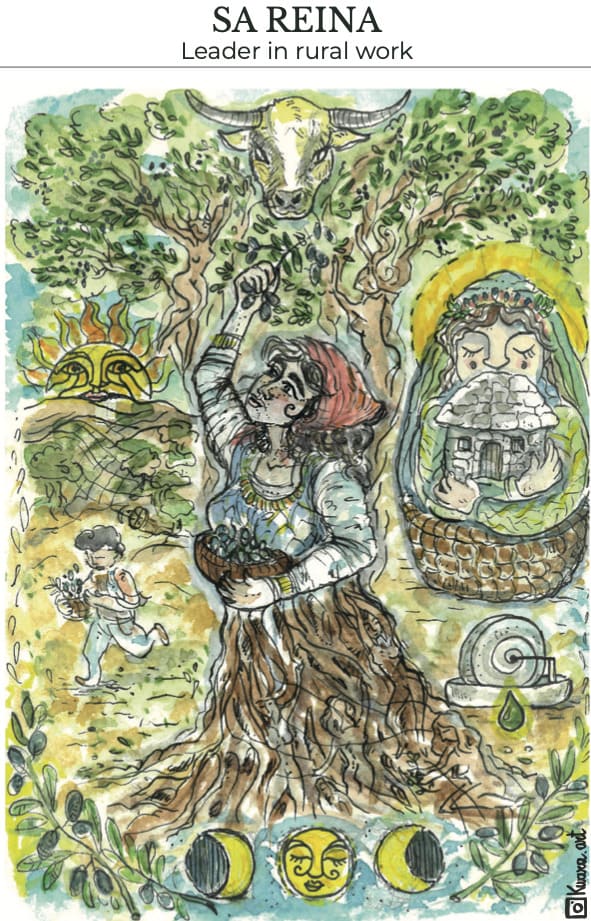
The EmpowHer Cards are an educational and reflective tool created within the EmpowHer Permaculture project. They consist of 13 illustrated cards, each inspired by a real women's practice, documented in different rural contexts in Italy, Greece, Serbia and Slovenia.
Each card connects:
- a traditional or community-based women's practice;
- a permaculture principle;
- a feminine quality;
- a symbolic and inspirational message.
The illustrations were created in watercolour by Italian artist Sara Quaranta (Quara), and are inspired both by women's practices and by the imagery of tarot cards.
What are the cards for?
The cards can be used in different contexts:
- personal reflection, to listen to oneself and find orientation;
- sharing circles, to open dialogues and storytelling;
- workshops and training paths, as an educational stimulus;
- facilitation and group processes;
- permaculture design, to explore emotional and symbolic dimensions;
- systemic constellations, as symbolic anchors.
There is no single right way to use them. The cards do not give answers: they open questions.
Some possible uses
Below are some of the ways the cards have been used during the project and beyond:
Card of the day
Pick a card in the morning and let it accompany your choices.
Sharing circles
Each participant receives a card and shares what it evokes: What resonates with me? How does it speak about my story or my potential?
Training and education
The cards become starting points to talk about care, sustainability, leadership and community.
Personal, collective and ecological levels
The cards can work on multiple levels: inner, relational, community-based, environmental.
A deck of practices, a deck of women
Each card tells a concrete women's practice: gestures of care, resistance, regeneration and vision, often passed down in silence. They are stories that remind us that women have always contributed to shaping the world, even when their role was not recognised.
Each practice is linked to a permaculture principle and a feminine quality, which emerged through research, fieldwork and collective learning during the project.
The cards can be read one at a time, or as parts of a single ecosystem: like a garden, made of relationships, balances and possibilities.
Download the cards here
The Booklet of women's practices
The booklet brings together research on traditional and contemporary women's practices that inspired the cards. It is a document of memory and vision, telling stories of practices rooted in territories and at the same time able to speak to the present.
Download the booklet of women's practices
The PDC Manual – Permaculture Design Course
Within the project, a Permaculture Design Course (PDC) was also developed, designed exclusively for women, with a regenerative, inclusive and accessible approach.
The PDC manual includes:
- theoretical content;
- educational practices;
- facilitation tools;
- the integration of the EmpowHer Cards as a working tool.
The manual is designed for educators, trainers, social workers and all women who wish to bring permaculture into their own lives and communities. It is a guide to creating an accredited PDC, to be included as a project in an Erasmus+ Training Course, in order to make it accessible, free and sustainable for participants and teachers.
Starting from the concept of decolonisation of permaculture, this project aims to bring permaculture to as many people as possible, because if permaculture stems from the knowledge of primitive peoples, it deserves to be reawakened in all of us, without economic limitations.
A European project
EmpowHer Permaculture is a project co-funded by the Erasmus+ programme – KA210-ADU, carried out by a European partnership working on permaculture, non-formal education and women's empowerment.
All project materials are designed to be freely accessible, shareable and reusable.
Acknowledgements
Massimo Candela
All the women of Dell'Asino e La Luna
Sara Quaranta
Project Number: 2024-1-IT02-KA210-ADU-000255126
Funded by the European Union. Views and opinions expressed are however those of the author(s) only and do not necessarily reflect those of the European Union or the European Education and Culture Executive Agency (EACEA). Neither the European Union nor EACEA can be held responsible for them.